Chrysler Nerds, I Need PCM Help (JTEC)

Buddy Holly

Professional Amateur
Joined
Apr 6, 2014
Location
North Raleigh
So I have been fighting an issue with a TJ for a hot minute now. My sanity has long since left the chat. This is long winded and bound to get very autistic, so strap in if you're keen. :popcorn:

Here's the deets:
02 Jeep TJ, 4.0/32RH Automatic, 95k miles

I've been chasing a heat related misfire for the past few years. The engine runs great when it's cool outside. Anything under 70 degrees it runs perfect. Above 70 it drops cylinders and starts flashing the check engine light when you sustain RPM over 2500 for more than a few seconds. P0300 (random multiple misfire), P0301-306 (individual cylinder misfires) usually come with it as well. When it drops a cylinder, it is DEAD. I can pull over, shut the engine off, restart and the misfire vanishes until the engine sustains 2500+ rpm again for more than a few seconds.

Things that have been done in the past two years to try and fix the problem (and others that arose):

New cylinder head from Clearwater (cracked 0331)
New Intake manifold to replace the original with a cracked runner
New replacement factory-style coil
"Viper" coil upgrade when the factory coil didn't change the symptom
OEM remanufactured injectors
Wranglerfix "reman" PCM
Champion Iridium spark plugs
Replaced all wiring from firewall forward with a used harness from a wrecked TJ. Replaced any broken connectors and split all the loom off to inspect the wires to ensure nothing was melted in the injector harness or with any of the engine sensors. All connections have dielectric grease.
All new battery and ground cables (1/0 AWG)


If you couldn't tell, this jeep had a ton wrong with it but this damn misfire issue persists through it all.

The injectors I did yesterday and thought I had it licked. Today it misfired again :handed: I can pull injector connectors on the affected cylinders with no change in how the engine runs. For reference, #2 and #5 usually dip out first, with #4 quickly behind. The previous injectors did the exact same thing. Next I tested the injector signals with the power probe and what I found is I am losing pulse soon as it sustains 2500+ for more than a few seconds. Thinking it was wiring related, I tore the harness apart and checked for anything melted or broken. Nothing found. For good measure I then checked injector pulse at the PCM connector and found the exact same issue with dropping injector pulse. It isn't a decay, it's immediate, like a switch was flipped.

My question for people who know more about these PCMs than I do: when the JTEC PCM detects a misfire on a specific cylinder, does it kill the injector pulse to prevent fuel from dumping into a cylinder that isn't igniting the mixture? The way I see it, I am stuck in a chicken or the egg situation right now. Either the PCM has an injector driver issue, or I have an ignition problem and that is causing my loss of injector pulse. I have dug through my FSM and a bunch of forum threads but I haven't gotten anywhere. Anybody have ideas? Is this a common thing for this era Chrysler PCM to shit injector drivers? Am I an idiot and missing something obvious?
 
Last edited:
May be the fuel is vapor locking. Had a similar issue years ago and got one of these heat shields, worked great.

Basically fuel vapor fills the end of the rail so the last 2 cylinders only get vapor not a full stream and that causes a misfire.

It makes since sense (😈) you only have a problem in higher temps.

It is also a common 4.0 problem with horseshoe intake years because those had a dead headed fuel rail

And the misfire is detected by the knock sensor reading a non harmonic frequency don’t know how it could tell where the misfire is, just that the pattern it expects is not happening.

A single sensor can detect non harmonics and that data can be extracted to tell where the frequency came from, but automotive knock sensors just say there’s a vibration above the threshold amplitude that’s out of time

https://external-content.duckduckgo...09740bd5c20bff7559b018feb2c66e195f&ipo=images
 
Last edited:
My educated guess here is that the bearings are worn on the camshaft synchronizer. When it gets spinning too fast it starts wobbling/chattering and the camshaft position sensor sees erratic movement so it thinks that the engine is stumbling. I had this exact same problem on a mid 00s Ranger 3.0 Vulcan engine years ago. Like the TJ 4.0 instead of an actual distributor they have this thing that plugs into the distributor hole and has a camshaft position sensor on it. There was not even 100k on it and it was worn out. The symptoms happened above 4000rpm on that engine but the effects were the same. I had already tried plugs and an ignition module but when I figured out how the ignition was timed I swapped this thing out and it ran like a top after that.

The TJ one is shown below (picture stolen from RockAuto). I know you do not want to keep throwing parts at it but this is the only ignition component that is directly tied to engine RPM due to the mechanical connection on the camshaft. And it is pretty inexpensive at $50 or so complete with a new sensor. If you do decide to replace it make sure you feed some engine oil into it and spin it around before installing so it does not run dry on startup; these do not oil well.

1741264705109.png


Us guys with older Nissans like mine have a similar issue when the distributor bearings go (usually in the 200k range) and the shaft wobbles and the optical pickup sends erratic data to the PCM.
 
Last edited:
This is a fairly common issue with most 00-around 04 TJ, WJ and XJs.
Feel on top of the oil pump drive (OG dizzy) and see if you can feel any tapping. If so, it's likely worn and *can* be the cause. Also, vapor lock is a huge deal on that era Jeep with the cats under the manifolds. If possible, and safely, after it does it, push in the shroader valve and see if air comes out (in place of fuel). If so, you have vapor lock. There are heat shields, aftermarket fuel rail shields (DEI Engineering) that help a little. Many times it's due to the cats being restricted. Unrestricting them ;) tends to help.
It's obviously not a mechanical failure like a flat cam lobe, broken valve spring, etc. It's a control thing, PCM detecting a misfire from vapor lock, etc.
Hell, I've seen a split serp belt cause a misfire back in the day.
 
Looking at how they're made, it wouldn't be a huge deal to braze/weld another fitting and make them flow through.

1741276585440.png


Doesn't seem like the pressure regulator is located on the rail.
That said, I'm assuming that the pump module has the reg integrated in it and moving away from that means you have to run a return line etc to the tank?
 
Looking at how they're made, it wouldn't be a huge deal to braze/weld another fitting and make them flow through.

View attachment 434694

Doesn't seem like the pressure regulator is located on the rail.
That said, I'm assuming that the pump module has the reg integrated in it and moving away from that means you have to run a return line etc to the tank?
correct. On top of the pump is the filter/regulator combo. You'd need to run a return line after adding a fitting on the rail.
Dimensionally, one could install a XJ/YJ early ZJ rail (with return fitting), gut the OEM regulator and rely on the rail mounted regulator assuming pressures are similar.
If memory serves, both are around 45 psi.
Or just gut the cats
 
I went and bought another crank sensor today, just in case since I don’t remember replacing it. I also re-loomed the wires that run over the head and manifolds with some better stuff since I already had it apart. Just for the sake of it I pulled the pcm apart and there is no sign of an injector driver issue, though they got sealant all over the board when they put it together. I drove around for 20 minutes in second gear turning 2800-3500 consistently and it never threw a CEL or flashed. It was also 47 here, so I don’t want to trust anything has been fixed. Anyways……

The cam sync has clearly been replaced in the last couple years and appears to be in good condition. I pulled the sensor off and checked rotational and lateral play with the housing still installed in the engine. Nothing that throws a red flag. Definitely no noise or any other signs of it being an issue, though I do plan on pulling it out to inspect for good measure. I ran out of time today to get that done.

@Jody Treadway Just to confirm, if the PCM detects a misfire will it kill injector pulse to that cylinder until it is reset? It makes sense that it would, but I haven’t been able to find anything official that confirms that in my FSM or the powertrain diagnostic manual.
 
This is a fairly common issue with most 00-around 04 TJ, WJ and XJs.
Feel on top of the oil pump drive (OG dizzy) and see if you can feel any tapping. If so, it's likely worn and *can* be the cause. Also, vapor lock is a huge deal on that era Jeep with the cats under the manifolds. If possible, and safely, after it does it, push in the shroader valve and see if air comes out (in place of fuel). If so, you have vapor lock. There are heat shields, aftermarket fuel rail shields (DEI Engineering) that help a little. Many times it's due to the cats being restricted. Unrestricting them ;) tends to help.
It's obviously not a mechanical failure like a flat cam lobe, broken valve spring, etc. It's a control thing, PCM detecting a misfire from vapor lock, etc.
Hell, I've seen a split serp belt cause a misfire back in the day.
The tighter the 🐱the hotter it is 😉
 
I went and bought another crank sensor today, just in case since I don’t remember replacing it. I also re-loomed the wires that run over the head and manifolds with some better stuff since I already had it apart. Just for the sake of it I pulled the pcm apart and there is no sign of an injector driver issue, though they got sealant all over the board when they put it together. I drove around for 20 minutes in second gear turning 2800-3500 consistently and it never threw a CEL or flashed. It was also 47 here, so I don’t want to trust anything has been fixed. Anyways……

The cam sync has clearly been replaced in the last couple years and appears to be in good condition. I pulled the sensor off and checked rotational and lateral play with the housing still installed in the engine. Nothing that throws a red flag. Definitely no noise or any other signs of it being an issue, though I do plan on pulling it out to inspect for good measure. I ran out of time today to get that done.

@Jody Treadway Just to confirm, if the PCM detects a misfire will it kill injector pulse to that cylinder until it is reset? It makes sense that it would, but I haven’t been able to find anything official that confirms that in my FSM or the powertrain diagnostic manual.
Going off memory (from late 90s driveability classes), yes the fuel injector(s) are turned off on suspect cylinders. That's an effort to keep raw fuel from damaging the cats in the event of an ignition misfire
 
Looking at how they're made, it wouldn't be a huge deal to braze/weld another fitting and make them flow through.

View attachment 434694

Doesn't seem like the pressure regulator is located on the rail.
That said, I'm assuming that the pump module has the reg integrated in it and moving away from that means you have to run a return line etc to the tank?

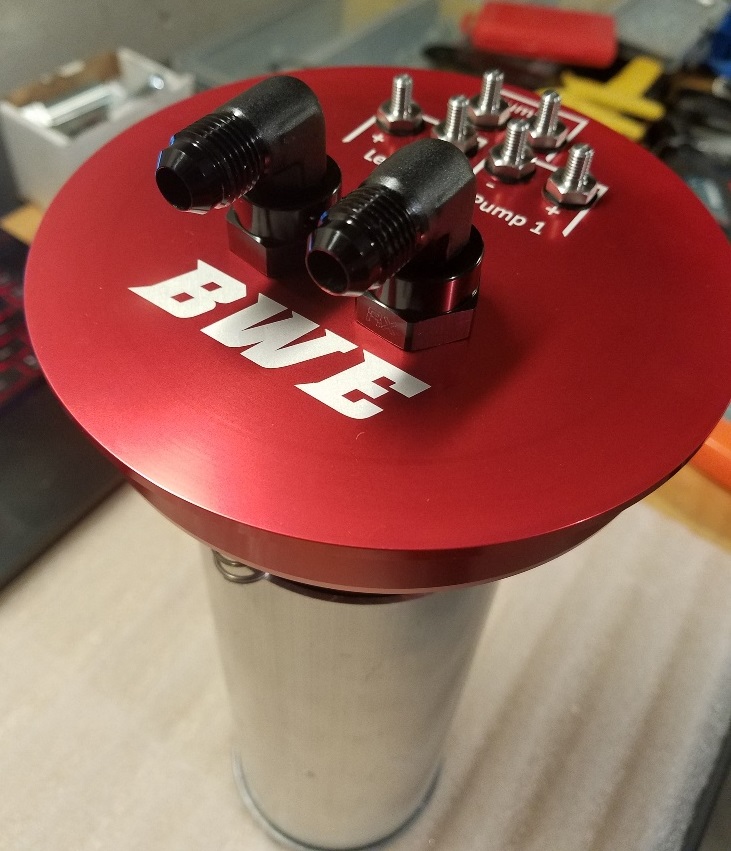
Boostwerks makes an aftermarket hat for the pump module that ditches the factory reg in favor of an external bypass regulator. Pretty neat setup once you get a rail with a return port.

 
Saw this on Savvy's IG just now.
 
Last edited:
Well, I ordered one of the rail kits for my wife's 4.7. So if you need any first hand feedback, holla.
You might or might not be concerned by this, but the flow path with the quick connect fitting (red) that is on these rails is pretty shit.

1742302284571.png


If you're going to a flow through rail, I'd use ORB fittings on the ends (in green) and make it flow nicely through it.
You can cut the welded fitting (red) and drill/tap that location for a 1/8npt plug or put a gauge there if you want one.
1742302048861.png
 
Being a dead head rail, wouldn't the back 3 ports be pressurized regardless? Running 19 lb/hr injectors on this application so outbound flow will be quite low compared to a HP application.
 
Being a dead head rail, wouldn't the back 3 ports be pressurized regardless? Running 19 lb/hr injectors on this application so outbound flow will be quite low compared to a HP application.
Absolutely.
But I pictured you going to such a rail to make it a flow-through and not dead-head.
If you're keeping it dead-head, why not keep the OEM one?
 
I dig that rail, but @Bebop is right, the fluid path sucks. I think I may try to modify a spare rail I have with some 6AN bungs for both feed and return, then cap the original feed.

Or…… use the factory feed port for the return. Might try that. Not sure.

Also! Long story short I may have fixed it. I don’t know if it was the cam sensor itself, the crank sensor, or the cam synchronizer dummy distributor thing. But I’ve driven the TJ every day since installing the new parts Sunday and I have not been kind to it. So far, no misfire! It definitely runs smoother too. The original cam sync had the sensor replaced but the rest was original. It had a fair amount of up-down thrust. The new Dorman unit is much tighter. I’ll keep reporting back if it stays cooperative.

The only issue now is even with the DEI heat shield kit installed I now have a hard hot start that began with the reman injectors. I have good fuel pressure but it bleeds off pretty quickly once the pump shuts off, but I don’t think it’s the pump since it builds to the correct pressure on first prime even from 0 psi. Cycling the key a few times to prime it doesn’t change the symptom. They don’t leak either, checked them with the rail removed from the intake.

Anyways I may try the Boostwerks pump hat and see about getting some AN hoses and a regulator to replumb the fuel system. For science :smokin:
 
For posterity’s sake I will also add that there is a way to check the angle difference between the cam and crank sensors. It requires from what I can gather the OEM Chrysler DRB III scan tool or a fancy bi-directional tool, but the jury is out on which specific models of scan tool will work. I’m waiting on a coworker to bring in his fancy MAC scanner, but I read the Autel 900 series as well as a few others have the functionality too. You can also command a cam/crank relearn on these engines with these tools.

Procedure is:
Hook up the scan tool and monitor the cam/crank angle while the engine is running. The PID is called CAM CRANK DIFFERENCE. Crack the hold-down on the cam sync and rotate until the reference angle difference is as close to zero as possible (while still running). Tighten the hold-down. Then command the cam/crank relearn (SET SYNC) so it learns the new reference angle. The engine has to be off to command the relearn. Then you just start it and resume peaceful existence (hopefully)
 
For posterity’s sake I will also add that there is a way to check the angle difference between the cam and crank sensors. It requires from what I can gather the OEM Chrysler DRB III scan tool or a fancy bi-directional tool, but the jury is out on which specific models of scan tool will work. I’m waiting on a coworker to bring in his fancy MAC scanner, but I read the Autel 900 series as well as a few others have the functionality too. You can also command a cam/crank relearn on these engines with these tools.

Procedure is:
Hook up the scan tool and monitor the cam/crank angle while the engine is running. The PID is called CAM CRANK DIFFERENCE. Crack the hold-down on the cam sync and rotate until the reference angle difference is as close to zero as possible (while still running). Tighten the hold-down. Then command the cam/crank relearn (SET SYNC) so it learns the new reference angle. The engine has to be off to command the relearn. Then you just start it and resume peaceful existence (hopefully)
that's how we did it at the dealer. As close to zero w/o it going negative.
 
Back
Top