Anyone following "Hydro's" Build on Pirate?

Generally Stainless steel is considered to be weaker than steel. But then again I pulled out the books and depending on which grade of stainless, it can be pretty stout. So assuming he used the good stuff, nothing wrong with his construction. I guess, as would be said on pirate, probably needs more triangulation. Just doesn't seem to have enough.

I think it is a good prototype. Something that adds a new dimension to our sport. I would've done it differently (but then again each individual would build a different rig) but I think this is a step in an interesting and new direction.

Oh and those Michelin tires SUCK. Hope he changes that.
 
It looks to me that it's more along the lines of a rolling business card for his fab work and engineering than an actual wheeler. It definatley sweet, not my cup of tea but each to his own and I can appreciate it for the skills, brains and time it took to build sonething like this.
 
Interesting

The hydrostatic system is a closed loop style with a tandem pump that is actually two pumps bolted together. The front pump and the front motors are in a closed loop so the oil that goes out of the pump and into the motors is the same oil that goes out the motors and back into the pump. That means that the oil is like a bike chain that is rotating through the hoses. The hydrostatic pumps are variable displacement which means that the pumps can vary there output based on the stroke of the pistons inside the pump. The stroke is determined by a hand lever on the pump. By changing the output of the pump you can speed up or slow down the motors. This system is almost a 1:1 ratio which means that at full output the pump and the motors will be going the same rpm. The pumps can start out as low as 0:1 output which is no oil circulating. As the hand controls move in an infinite ratio, the pistons start to stroke and the chain of oil starts to circulate through the pump and motors.

The front pump, pumps out oil into the right front wheel motor and the oil spins through the motor and then the oil is sent to the left front wheel motor where it spins through the motor and then is sent back to the front pump to be recirculated again. This is called a series system.

The relief on the pump is set at 5000 PSI, if the pump sees more than that pressure the oil is pumped over a relief and recirculated at no higher than 5000 PSI. The closed loop looses oil in the form of internal leakage which is sent back to the tank. This oil has to be replaced. The charge pumps job is to constantly feed the hydrostatic pumps with low pressure (300 PSI) oil back into the low pressure side or slack side of the loop. This way the lines are always full of oil.
The charge pump is about 15 GPM which is more than what is needed to keep the loops full of oil due to leakage. Each hydrostatic pump is moving at 48 GPM. With the front and rear pumps at full output, 96 GPM the reservoir only sees 15 GPM of recirculating oil. This is how the reservoir can be smaller than a conventional open loop system.

The charge pump also does double duty as the filter pump. The oil is picked up at the tank and pumped into an 8 micron rated filter at 300 PSI which is sent to replenish the hydrostats with clean oil. The charge pump also uses the excess of the 15 GPM to mix with the hot leakage oil in the pump cases and sends that oil into the cooler to cool down before being dumped into the tank for reuse.

The tank is designed to trap oil in the suction area and keep the air bubbles at the top of the tank. The shape of the tank and the pickup points will allow the air pocket to always stay away from the suction ports when sloshing around. The return oil enters the top of the tank and is spun against the sides of the tank to help release any air bubbles that might be in the oil. The tank shape makes the oil take the longest route possible back to the suction ports so the oil has a chance to dwell and let the bubbles work their way out before being sent back to the pump. The tank can hold about 22 gal. and the rest (3 gal) of the oil is held in the pumps, motors, cooler and hoses.

The cooler is rated at 12 HP or 30,000 BTU. The oil can absorb heat during relief dumps and maintain a usable temp of under 180 degree. The cooler will constantly be cooling down the oil so it will be ready to absorb more heat during a relief situation. Under normal driving conditions the BTU's created are low enough that the cooler can maintain an acceptable operating temperature while preparing the oil to absorb the full 150 HP heat ups that only last a couple seconds.

DSC01665.jpg


DSC01667.jpg


DSC01669.jpg
 
The original idea for the buggy came from working on the ASABE 1/4 Scale Tractor design competition when at Cal Poly. Our team built conventional mechanical while the other teams built full hydraulic. I saw the pros and cons of both setups and decided that for a crawler it would work well.

The design started in 2004 with research on pumps, motors, engines, and chassis. The first sketches looked very different from what it has turned out to be, due to design constraints of the suspension and hydraulics. The suspension was the starting point once I had an idea of hydraulic drivetrain sizes. I have read many statements about the suspension and how it could have been designed for much more ground clearance. I do agree with this, however the hydraulics took priority of the suspension design. The hoses are not as flexible as one would think or capable of rubbing against moving and turning suspensions. The motors themselves are fine structurally but are made to be lightweight and could not handle a bump from a rock or stump. The suspension is dual function as a ride system and a moving guard for the hoses and motors. The chassis was then designed around all the parts that the buggy would need and there location for best performance. The chassis was designed and built for reliability and resistance to damage. I did not want to try and save weight and take the chance of breaking down. The hydraulics themselves are safeguarded by the relief's which safeguard the planetaries, steering, and chassis. The reliability of the buggy should be very high as a system.

The fabrication started once the design was set and just about every part on the buggy was cut to the print. The square and rectangle tube allows for precise fitting and joints and in order for the joints to work the shape and location of the material must all flow from one point to another. Unlike round tube with 0-360 degree increments the square angles must come off at 90 degree increments. This had a large factor in the look and lines of the buggy. It also made it easier to build as the compound angles were minimal. All the welding was TIG done by myself which made for very slow fabrication but also very clean and precise fabrication with a mental image of how strong each weld is on the buggy. The flat plate design and cnc cutting allows for precision parts but also creates allot of welding as every piece must be welded together. Bending would allow for a much faster build but again the bending is not as precise as a welded joint. For safety in the occupant area I joined tubes together in a way to reinforce and minimize the potential for a broken loose tube. The roof is also a shear plate and secured to the beams to control them in case of a joint failure.

The floors are also designed to support the cage across there full area while keeping a minimal contact area to obstacles under them. The upright seating position was chosen for comfort as well as a way to put the front tire as close to the floor as possible. The idea behind this is for the front tire to come off the obstacle and the floor to ride on top of it for the shortest length possible, then the area is open until the rear tire contacts the obstacle. If the void it small enough then the possibilities for hanging up are reduced. The floor bottom will be covered in UHMW to slide.

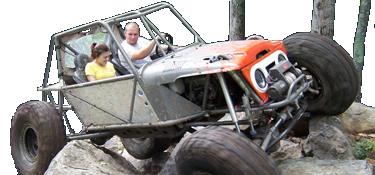
The original idea for the buggy came from working on the ASABE 1/4 Scale Tractor design competition when at Cal Poly. Our team built conventional mechanical while the other teams built full hydraulic. I saw the pros and cons of both setups and decided that for a crawler it would work well.

The design started in 2004 with research on pumps, motors, engines, and chassis. The first sketches looked very different from what it has turned out to be, due to design constraints of the suspension and hydraulics. The suspension was the starting point once I had an idea of hydraulic drivetrain sizes. I have read many statements about the suspension and how it could have been designed for much more ground clearance. I do agree with this, however the hydraulics took priority of the suspension design. The hoses are not as flexible as one would think or capable of rubbing against moving and turning suspensions. The motors themselves are fine structurally but are made to be lightweight and could not handle a bump from a rock or stump. The suspension is dual function as a ride system and a moving guard for the hoses and motors. The chassis was then designed around all the parts that the buggy would need and there location for best performance. The chassis was designed and built for reliability and resistance to damage. I did not want to try and save weight and take the chance of breaking down. The hydraulics themselves are safeguarded by the relief's which safeguard the planetaries, steering, and chassis. The reliability of the buggy should be very high as a system.

The fabrication started once the design was set and just about every part on the buggy was cut to the print. The square and rectangle tube allows for precise fitting and joints and in order for the joints to work the shape and location of the material must all flow from one point to another. Unlike round tube with 0-360 degree increments the square angles must come off at 90 degree increments. This had a large factor in the look and lines of the buggy. It also made it easier to build as the compound angles were minimal. All the welding was TIG done by myself which made for very slow fabrication but also very clean and precise fabrication with a mental image of how strong each weld is on the buggy. The flat plate design and cnc cutting allows for precision parts but also creates allot of welding as every piece must be welded together. Bending would allow for a much faster build but again the bending is not as precise as a welded joint. For safety in the occupant area I joined tubes together in a way to reinforce and minimize the potential for a broken loose tube. The roof is also a shear plate and secured to the beams to control them in case of a joint failure.

The floors are also designed to support the cage across there full area while keeping a minimal contact area to obstacles under them. The upright seating position was chosen for comfort as well as a way to put the front tire as close to the floor as possible. The idea behind this is for the front tire to come off the obstacle and the floor to ride on top of it for the shortest length possible, then the area is open until the rear tire contacts the obstacle. If the void it small enough then the possibilities for hanging up are reduced. The floor bottom will be covered in UHMW to slide.


ai184.photobucket.com_albums_x141_HydroDynamicCrawler_FullScaleTop0131.jpg


ai184.photobucket.com_albums_x141_HydroDynamicCrawler_FullScale0131.jpg


ai184.photobucket.com_albums_x141_HydroDynamicCrawler_DSC01257.jpg


ai184.photobucket.com_albums_x141_HydroDynamicCrawler_DSC01259.jpg


ai184.photobucket.com_albums_x141_HydroDynamicCrawler_DSC01290.jpg

.
 
Well funny you say that,
You either like what he has built or you hate and flame it, But as far as the tubing it wasn't ever about that.
A few question or issues people had are, Brakes, It has none, COG and Ground Clearance were also big concerns.


I have been browsing through the pics, and i cannot figure out the steering.


I must say that i am truly jealous of his fab skills, and he obviously knows what the hell he is doing. Cant wait to see some real action photos.
 
I have browsing through the pics, and i cannot figure out the steering. I must say that i am truly jealous of his fab skills, and he obviously knows what the hell he is doing. Cant wait to see some real action photos.

ai184.photobucket.com_albums_x141_HydroDynamicCrawler_DSC01454.jpg
ai184.photobucket.com_albums_x141_HydroDynamicCrawler_DSC01455.jpg
DSC01662.jpg


You can sorta see it in the pictures above, the ram is mounted so that the whole thing slides moving the arms left and right, He had a video in the first thread that was deleted. It is hard to understand until you see it work.
 
**Snip**

Oh and those Michelin tires SUCK. Hope he changes that.

I finally got back into the garage and at it again.
Gensco got a new shipment of tires in so I am picking up a set of the Goodyear MVTs. They are 46"x15" and weight 205 lbs compared to the Mich 53"x16"@ 325 lbs. Instant 480 lb weight loss. They are 2003 build year.
It takes some time to break down the setup but it is done. The reduced mass should help things out as they are closer to the original design size and weight.
Half of the steering is put back together and I'm doing the rear parts at the same time so I can change the rear out to make everything match.
I am also putting together the trailer together in hopes of taking it to KOH.

As for the tires I wanted to be as cheap as possible to save for the rest of the build. I lucked out in finding Gensco and they will let me try out their tires and see which ones will work best. The MVTs just came in so I wanted to try them out.
.
 
I just looked at the steering. Either it is epic clever or is going to fall apart and die. There is no in between :lol:.

His mind is definitely thinking outside the box. That ram setup for the rear steer too me a few moments to figure out. It looked like it was bolted to itself (from that angle).

I think this rig is going to evolve with more ideas to better adapt it to what the owner wants it to do. Too much new territory has been entered for it to be right the first time.
 
whatcha say there, HEAVY
 
very unique id have to say, its an awesome idea, but why if hes such a good fabricator did he make the ground clearance so little? there are plenty of independent rigs with good clearance. thats the only thing that doesnt make sense to me

He'sa skilled fabricator. meaning he's clearly very good at and particular about building things. nobody could do that much TIG work at that level w/o being at least mildly OCD about it.
That dosn't mean he has good sense about the application and what may be practical problems later though.

Clearly he's more interested in the journey than the destination - good for him for striking out on his own like that. Need more people like thsi in the world.
 
I have been browsing through the pics, and i cannot figure out the steering.
I must say that i am truly jealous of his fab skills, and he obviously knows what the hell he is doing. Cant wait to see some real action photos.


It uses a hydraulic rack like all of the trophy truck guys use in the rear, in the front it uses a rack connected to a steering box. With all of his hydraulic prowess, I think it's a bit ridiculous he didn't go with a ram up front too. But again, the guy is definitely different.
 
Back
Top