The original idea for the buggy came from working on the ASABE 1/4 Scale Tractor design competition when at Cal Poly. Our team built conventional mechanical while the other teams built full hydraulic. I saw the pros and cons of both setups and decided that for a crawler it would work well.
The design started in 2004 with research on pumps, motors, engines, and chassis. The first sketches looked very different from what it has turned out to be, due to design constraints of the suspension and hydraulics. The suspension was the starting point once I had an idea of hydraulic drivetrain sizes. I have read many statements about the suspension and how it could have been designed for much more ground clearance. I do agree with this, however the hydraulics took priority of the suspension design. The hoses are not as flexible as one would think or capable of rubbing against moving and turning suspensions. The motors themselves are fine structurally but are made to be lightweight and could not handle a bump from a rock or stump. The suspension is dual function as a ride system and a moving guard for the hoses and motors. The chassis was then designed around all the parts that the buggy would need and there location for best performance. The chassis was designed and built for reliability and resistance to damage. I did not want to try and save weight and take the chance of breaking down. The hydraulics themselves are safeguarded by the relief's which safeguard the planetaries, steering, and chassis. The reliability of the buggy should be very high as a system.
The fabrication started once the design was set and just about every part on the buggy was cut to the print. The square and rectangle tube allows for precise fitting and joints and in order for the joints to work the shape and location of the material must all flow from one point to another. Unlike round tube with 0-360 degree increments the square angles must come off at 90 degree increments. This had a large factor in the look and lines of the buggy. It also made it easier to build as the compound angles were minimal. All the welding was TIG done by myself which made for very slow fabrication but also very clean and precise fabrication with a mental image of how strong each weld is on the buggy. The flat plate design and cnc cutting allows for precision parts but also creates allot of welding as every piece must be welded together. Bending would allow for a much faster build but again the bending is not as precise as a welded joint. For safety in the occupant area I joined tubes together in a way to reinforce and minimize the potential for a broken loose tube. The roof is also a shear plate and secured to the beams to control them in case of a joint failure.
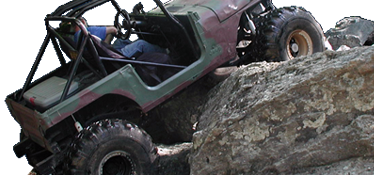
The floors are also designed to support the cage across there full area while keeping a minimal contact area to obstacles under them. The upright seating position was chosen for comfort as well as a way to put the front tire as close to the floor as possible. The idea behind this is for the front tire to come off the obstacle and the floor to ride on top of it for the shortest length possible, then the area is open until the rear tire contacts the obstacle. If the void it small enough then the possibilities for hanging up are reduced. The floor bottom will be covered in UHMW to slide.
The original idea for the buggy came from working on the ASABE 1/4 Scale Tractor design competition when at Cal Poly. Our team built conventional mechanical while the other teams built full hydraulic. I saw the pros and cons of both setups and decided that for a crawler it would work well.
The design started in 2004 with research on pumps, motors, engines, and chassis. The first sketches looked very different from what it has turned out to be, due to design constraints of the suspension and hydraulics. The suspension was the starting point once I had an idea of hydraulic drivetrain sizes. I have read many statements about the suspension and how it could have been designed for much more ground clearance. I do agree with this, however the hydraulics took priority of the suspension design. The hoses are not as flexible as one would think or capable of rubbing against moving and turning suspensions. The motors themselves are fine structurally but are made to be lightweight and could not handle a bump from a rock or stump. The suspension is dual function as a ride system and a moving guard for the hoses and motors. The chassis was then designed around all the parts that the buggy would need and there location for best performance. The chassis was designed and built for reliability and resistance to damage. I did not want to try and save weight and take the chance of breaking down. The hydraulics themselves are safeguarded by the relief's which safeguard the planetaries, steering, and chassis. The reliability of the buggy should be very high as a system.
The fabrication started once the design was set and just about every part on the buggy was cut to the print. The square and rectangle tube allows for precise fitting and joints and in order for the joints to work the shape and location of the material must all flow from one point to another. Unlike round tube with 0-360 degree increments the square angles must come off at 90 degree increments. This had a large factor in the look and lines of the buggy. It also made it easier to build as the compound angles were minimal. All the welding was TIG done by myself which made for very slow fabrication but also very clean and precise fabrication with a mental image of how strong each weld is on the buggy. The flat plate design and cnc cutting allows for precision parts but also creates allot of welding as every piece must be welded together. Bending would allow for a much faster build but again the bending is not as precise as a welded joint. For safety in the occupant area I joined tubes together in a way to reinforce and minimize the potential for a broken loose tube. The roof is also a shear plate and secured to the beams to control them in case of a joint failure.
The floors are also designed to support the cage across there full area while keeping a minimal contact area to obstacles under them. The upright seating position was chosen for comfort as well as a way to put the front tire as close to the floor as possible. The idea behind this is for the front tire to come off the obstacle and the floor to ride on top of it for the shortest length possible, then the area is open until the rear tire contacts the obstacle. If the void it small enough then the possibilities for hanging up are reduced. The floor bottom will be covered in UHMW to slide.











 .
.

