What's a stroked 4.0 cost

I have close to $3500 in mine when it was said and done. I bought the stroker kit from Cleggs Jeep 4.0 Stroker Kits - Stroker Kits ($1000) machine work was close to the same. Then cam, timing chain, 62mm throttle body, injectors, header, and all the little misc stuff it adds up in a hurry to do things right. but i will say it still puts a smile on my face everytime I drive it. The off the line response and low end torque is awesome. Not much that it won't hang with stop light to stop light. Just runs out of breath at the higher rpms (which could be cured with more head work and $$)
 
can one of you guys that has built one key up a good recipe? what cam, injectors? some of the misc. stuff? I am thinking of starting to collect to do this too..
 
can one of you guys that has built one key up a good recipe? what cam, injectors? some of the misc. stuff? I am thinking of starting to collect to do this too..
Read and learn:
Stroker
And here it is (edited to meet 12,000 character requirement...) for future reference:
4.0 engine torque curves

The torque curve of the engine in stock form was already broad and flat. The addition of some simple bolt-on performance modifications increased torque throughout the rev range, particularly at higher revs.
Maximum horsepower increased from 193hp @ 4850rpm to 235hp @ 5200rpm, and maximum torque from 239lbft @ 3500rpm to 269lbft @ 4000rpm. The torque curve is broader, with at least 242lbft (1.0lbft/ci) available from 1600rpm to 5100rpm. This translates into faster acceleration at any speed in any gear making passing manoeuvres safer. Gas mileage remained the same despite the higher HP/TQ outputs thus reflecting the engine's greater efficiency.
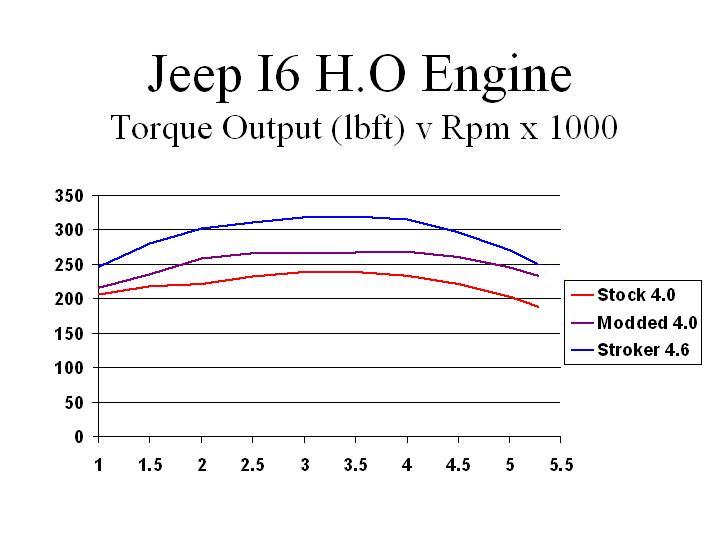
awww.jeep4.0performance.4mg.com_images_Torque.jpg
When 4.0 litres and 269lbft aren't enough...

There's no replacement for displacement so if you want even more torque, you need a bigger engine.
The 4.0L engine has a 3.411" stroke, 3.875" bore, 6 cylinders, and a displacement of 241.5ci (3956cc).
You can increase the displacement of your 4.0L engine by installing a stroker kit.
At the heart of the kit is the 3.895" stroke crankshaft that was used in the AMC/Jeep 258ci (4.2L) I6 engine.
On an engine with the standard 3.875" bore, the stroker crank increases displacement to 276ci (4517cc or 4.5L).
Add 30 thou or 60 thou overbore pistons and displacement is increased to 280ci (4587cc or 4.6L) and 284ci (4657cc or 4.7L) respectively.
Larger displacements will require custom parts. For a 4.8L stroker (4759cc or 290ci), 60 thou overbore pistons and a custom billet 3.98" stroke crank are required. If a custom billet 4.06" stroke crank is used, displacement is increased to 4.9L (4855cc or 296ci). The ultimate stroker would be a 5.0L version (5016cc or 306ci) with the block resleeved to accommodate 4.00" bore pistons and the aforementioned custom billet 4.06" stroke crank.
Here's some information on how you can build a stroker engine and the kits available.

Budget stroker build-ups

Robert Bryce built the world's first budget Jeep I-6 stroker engine, reusing as many stock components as possible in his assembly to keep cost to a minimum. The key to success was to keep it simple. Click on the image to the right to find out more.
Not to be outdone, I also jumped onto the stroker bandwagon and built the world's first "square" Jeep I-6 stroker engine with a bore and stroke of 3.895". It's identical to the 4.6L "poor man's" stroker shown below except that I used a Crane 753905 camshaft. I transformed a junkyard 4.0L short block plus a pile of parts into a rip-snorting torque monster with a displacement of 4563cc, hence I entitled my stroker story "From Junker to Stroker".
My stroker engine's producing a calculated 258hp @ 4850rpm and 320lbft @ 3500rpm. At least 278lbft (1.0lbft/ci) is available from 1500 to 4850rpm. The difference in performance over the old modified 4.0 is very noticeable, particularly from 1500-4000rpm where I need it most. Performance-wise, the stroker engine has hit the bullseye!


Stroker combinations
I've outlined several stroker combinations from mild to wild below based on budget and desired horsepower levels. To get maximum benefit from the stroker engine you need a free-flow intake with an S&B or K&N cone filter, 62mm bored HO throttle body, header, high-flow cat, performance muffler and 2.5" exhaust piping.

4.6L Low-buck, low CR "rockcrawler"

Jeep 4.2L 3.895" stroke crank
Jeep 4.0L 6.125" rods
Custom forged +0.030" bore pistons, compression height 1.380", dish volume 32cc
8.8:1 CR
CompCams 68-115-4 192/200 degree camshaft
DIY ported HO 1.91"/1.50" 57cc cylinder head
Mopar/Victor 0.043" head gasket
0.043" quench height
Ford 24lb/hr injectors for '87-'95 engines, Bosch 0280155703 injectors for '96-'04 engines, '98 Chevy LS1 25.2lb/hr injectors for '05-'06 engines
242hp @ 4600rpm, 317lbft @ 3000rpm

4.6L Modified "poor man's" stroker


Jeep 4.2L 3.895" stroke crank
Jeep 4.0L 6.125" rods
Custom forged +0.020" bore pistons, compression height 1.380", dish volume 26cc
9.25:1 CR
Stock 4.0 camshaft
DIY ported HO 1.91"/1.50" 57cc cylinder head
Mopar/Victor 0.043" head gasket
0.043" quench height
Ford 24lb/hr injectors for '87-'95 engines, Bosch 0280155703 injectors for '96-'04 engines, '98 Chevy LS1 25.2lb/hr injectors for '05-'06 engines
249hp @ 4900rpm, 303lbft @ 3500rpm ('87-'95 camshaft)
245hp @ 4700rpm, 315lbft @ 3000rpm ('96-'04 camshaft)

Original "poor man's" stroker

Same as above but with Jeep 4.2L 5.875" rods and Sealed Power 677CP +0.020" bore pistons. Unfortunately the high 0.088" quench height makes this combination more sensitive to detonation if the fuel quality is poor. This deficiency was rectified with the use of longer 4.0L connecting rods and custom forged pistons. This modified version is a great stroker build for a mild supercharger/turbo application with up to 6psi of boost. The 4.0L connecting rod/forged piston combination offers less reciprocating mass than the 4.2L rod/677P piston combination, thereby giving this engine a potentially higher rpm capability than the original "poor man's" stroker. The tight quench also allows this engine to run on 87 octane fuel in naturally-aspirated form.

4.6L low-buck stroker
Jeep 4.2L 3.895" stroke crank
Jeep 4.0L 6.125" rods
Custom forged +0.030" bore pistons, compression height 1.380", dish volume 18cc
9.6:1 CR
CompCams 68-231-4 206/214 degree camshaft
Russ Pottenger ported HO 2.00"/1.55" 62cc cylinder head
Mopar/Victor 0.043" head gasket
0.043" quench height
Ford 24lb/hr injectors with adjustable FPR or MAP adjuster for '87-'95 engines, Ford 24lb/hr injectors for '96-'04 engines, '99-'00 Chevy LS1 26.2lb/hr injectors for '05-'06 engines
268hp @ 4900rpm, 326lbft @ 3500rpm

NEW: Propane Conversion Special

Same as above except:

Custom forged +0.030" bore pistons, compression height 1.380", 5cc valve reliefs
11.0:1 CR
267hp @ 4900rpm, 323lbft @ 3500rpm

If you all thought that the old AMC 232 I6 crankshafts were only destined for scrapheap oblivion, think again. There are plenty of them around and with a 3.500" stroke, you can use them to convert a stock 4.0L engine into a 4.2L mini-stroker. While it doesn't have the displacement of an AMC 258 crank-based stroker, the 258 cranks are becoming increasingly scarce and expensive so a mini-stroker offers a low cost alternative to more HP/TQ:

4.2L Milder mini-stroker

AMC 232 3.500" stroke crank
Jeep 4.0L 6.125" rods
Silvolite UEM-2229 +0.060" bore pistons
Increase piston dish volume to 24cc
8.8:1 CR
CompCams 68-115-4 192/200 degree camshaft
DIY ported HO 1.91"/1.50" 57cc cylinder head
Mopar/Victor 0.043" head gasket
0.040" quench height
Ford 24lb/hr injectors for '87-'95 engines, Bosch 0280155703 injectors for '96-'04 engines, '98 Chevy LS1 25.2lb/hr injectors for '05-'06 engines
241hp @ 5000rpm, 293lbft @ 3500rpm

4.2L Wilder mini-stroker

AMC 232 3.500" stroke crank
Jeep 4.0L 6.125" rods
Silvolite UEM-2229 +0.060" bore pistons
9.6:1 CR
CompCams 68-235-4 210/218 degree camshaft
Russ Pottenger ported HO 2.00"/1.55" 62cc cylinder head
Mopar/Victor 0.043" head gasket
0.040" quench height
Ford 24lb/hr injectors with adjustable FPR or MAP adjuster for '87-'95 engines, Ford 24lb/hr injectors for '96-'04 engines, '99-'00 Chevy LS1 26.2lb/hr injectors for '05-'06 engines
268hp @ 5300rpm, 303lbft @ 3900rpm
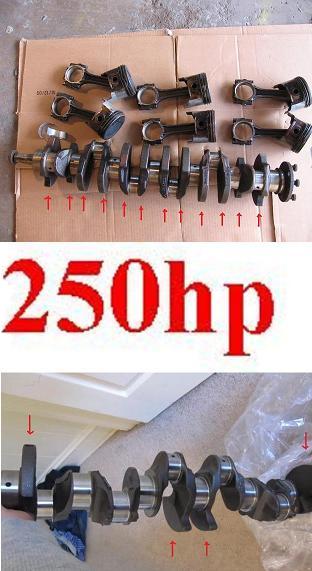
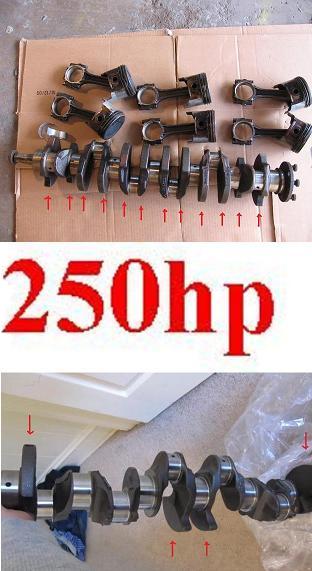
awww.jeep4.0performance.4mg.com_images_250hp.jpg
awww.jeep4.0performance.4mg.com_images_300hp_300x137.jpg
4.7L medium-buck stroker
Jeep 4.2L 3.895" stroke crank
Jeep 4.0L 6.125" rods
Custom forged +0.060" bore pistons, compression height 1.380", dish volume 15cc
10.2:1 CR
CompCams 68-235-4 210/218 degree camshaft
Russ Pottenger ported Edelbrock 60cc aluminum cylinder head
Mopar/Victor 0.043" head gasket
0.043" quench height
Flometrics F&B 68mm billet TB
Accel 30lb/hr injectors for '87-'95 engines, Bosch 0280155784 injectors for '96-'04 engines, '01-'02 Chevy LS1/LS6 28.6lb/hr injectors for '05-'06 engines
290hp @ 5100rpm, 340lbft @ 3700rpm

4.8L high-buck stroker

Custom billet 3.98" stroke crank
Jeep 4.0L 6.125" rods
Keith-Black UEM-IC944-060 pistons
10.0:1 CR
505 Performance 267/282-14HRK hydraulic roller camshaft
Russ Pottenger ported Edelbrock 60cc aluminum cylinder head
Felpro 0.051" head gasket
0.036" quench height
Flometrics F&B 68mm billet TB
Dual 2.25" exhaust system
Custom PCM programming
330hp @ 5400rpm, 366lbft @ 4000rpm

4.9L high-buck stroker
Custom billet 4.06" stroke crank
Eagle forged 6.15" rods
Custom forged +0.060" bore pistons, compression height 1.275", dish volume 12cc
11.0:1 CR
505 Performance 273/273-14HR hydraulic roller camshaft
Russ Pottenger ported Edelbrock 60cc aluminum cylinder head
Mopar/Victor 0.043" head gasket
0.043" quench height
Flometrics F&B 68mm billet TB
Dual 2.25" exhaust system
Custom PCM programming
340hp @ 5300rpm, 384lbft @ 4000rpm

5.0L very high-buck stroker

Same as above except:

Block resleeved to 4.00" bore diameter
Custom forged 4.00" bore pistons, compression height 1.275", dish volume 11cc
11.5:1 CR
505 Performance 281/281-14HR hydraulic roller camshaft
360hp @ 5500rpm, 391lbft @ 4100rpm
 
Mine is the:
"Original "poor man's" stroker

Same as above but with Jeep 4.2L 5.875" rods and Sealed Power 677CP +0.020" bore pistons. Unfortunately the high 0.088" quench height makes this combination more sensitive to detonation if the fuel quality is poor. This deficiency was rectified with the use of longer 4.0L connecting rods and custom forged pistons. This modified version is a great stroker build for a mild supercharger/turbo application with up to 6psi of boost. The 4.0L connecting rod/forged piston combination offers less reciprocating mass than the 4.2L rod/677P piston combination, thereby giving this engine a potentially higher rpm capability than the original "poor man's" stroker. The tight quench also allows this engine to run on 87 octane fuel in naturally-aspirated form."

I recommend something like:
"4.6L Modified "poor man's" stroker

Jeep 4.2L 3.895" stroke crank
Jeep 4.0L 6.125" rods
Custom forged +0.020" bore pistons, compression height 1.380", dish volume 26cc
9.25:1 CR
Stock 4.0 camshaft
DIY ported HO 1.91"/1.50" 57cc cylinder head
Mopar/Victor 0.043" head gasket
0.043" quench height
Ford 24lb/hr injectors for '87-'95 engines, Bosch 0280155703 injectors for '96-'04 engines, '98 Chevy LS1 25.2lb/hr injectors for '05-'06 engines
249hp @ 4900rpm, 303lbft @ 3500rpm ('87-'95 camshaft)
245hp @ 4700rpm, 315lbft @ 3000rpm ('96-'04 camshaft)"

Mine still has stock cam, stock head, stock injectors, stock airbox, etc.
 
what about computer tuning?
 
what about computer tuning?

The older engine control systems (Renix and OBD1) didn't require much tuning. You could make adjustments to fuel via adjustable regulators and larger injectors.
The newer OBD2 systems can be a little more finicky but I haven't encountered one where a local tuner couldn't make a few adjustments if needed.
As long as the cam choice isn't so far removed from stock, very little tuning is generally required.
 
I am going to start collecting parts for this. What is the better year model block & head to look for?
 
I had newcomer racing build me a 4.6 stroker for my last buggy. It wasnt cheap, but it performed well and really woke the buggy up.

I also have a 2wd comanche with a 4.7 stroker. That thing is a blast to drive and a hand full on wet roads.

For the price of all the parts and machining I felt better having someone that knew what they were doing put mine together. If you are willing to pay for it you will not regret it.

Newcomer rebuilt the V10 in my dodge when I cracked the block, did a great job.
 
I am going to start collecting parts for this. What is the better year model block & head to look for?
It is said the 96-99 nvh block is the best and the 91-95 7120 casting head is the best combo.

I used the 0630 head i had and have no complaints other than I did not have the new edelbrock aluminum head in my budget. ..lol

Sent from my SM-G860P using Tapatalk
 
Stick with 4.0 rods ( I think 2000+ are better but I'm not 100% sure). 87-90 4.2 cranks are lighter and will spin up faster, the pre-86 ones are heavier and will feel like they have more torque at low rpms because of the higher rotating mass. Also, the 87-90 cranks have the same harmonic balancer snout as 96+, whereas the older ones are longer and have to be machined.

I can only recall 2 really unexpected issues. I needed 4.0 crank main bearings instead of 4.2 (came with the 4.2 crank, but the axial alignment notch didn't line up, I just modified the block with a file). Theverything inside and outside diameters and oiling holes were the same, it was just a machining difference in the 4.0/4.2 blocks.
Also, the crank bearing cap stud girdle (ties all the main bearing caps together for strength) had to be spaced off the block about 1/16"-1/8" to give sufficient clearance for the bigger stroke. I used a lockwasher under it at each bolt. May not be perfect, but 13 years and 50k hard miles later, it's still going strong.
 
Last edited:
Stick with 4.0 rods ( I think 2000+ are better but I'm not 100% sure). 87-90 4.2 cranks are lighter and will spin up faster, the pre-86 ones are heavier and will feel like they have more torque at low rpms because of the higher rotating mass. Also, the 87-90 cranks have the same harmonic balancer snout as 96+, whereas the older ones are longer and have to be machined .

87-90 snout and balancer as 91-95 also, not just 96+
 
I never have understood the fascination with these things. If you live in a state where you can't change the motor out...sure.

But in NC? If you want more power, swap a V-8 in there. A half-ass small block will make more power on 7 cylinders than a $3500 stroker 4.0...nevermind what an LS swap would do.

If that's what you want, fine...not really trying to crap on your parade, but it seems to me like a V-8 is really what you guys want, and you're not saving any significant $$ by stroking, and not ending up with the power a V-8 would have for the same or less $$ as well.

Just my .02, for those that are thinking about it, not the ones that already did it.
 
I never have understood the fascination with these things. If you live in a state where you can't change the motor out...sure.

But in NC? If you want more power, swap a V-8 in there. A half-ass small block will make more power on 7 cylinders than a $3500 stroker 4.0...nevermind what an LS swap would do.

If that's what you want, fine...not really trying to crap on your parade, but it seems to me like a V-8 is really what you guys want, and you're not saving any significant $$ by stroking, and not ending up with the power a V-8 would have for the same or less $$ as well.

Just my .02, for those that are thinking about it, not the ones that already did it.

WAY more work to do a V8 swap.
 
I never have understood the fascination with these things. If you live in a state where you can't change the motor out...sure.

But in NC? If you want more power, swap a V-8 in there. A half-ass small block will make more power on 7 cylinders than a $3500 stroker 4.0...nevermind what an LS swap would do.

If that's what you want, fine...not really trying to crap on your parade, but it seems to me like a V-8 is really what you guys want, and you're not saving any significant $$ by stroking, and not ending up with the power a V-8 would have for the same or less $$ as well.

Just my .02, for those that are thinking about it, not the ones that already did it.
Most uneducated people assume v8s make way more power than they actually do. I have around $1000 in mine and it's the 275-295hp recipe. Should make more torque at 1000 rpm than any small block out there. If I was in to rock bouncing I would have a v8 for the higher rpm hp. Since my jeep is a crawler that is mostly going to be idling down the trails, the added rotating mass of the old 258 crank and the 300+ lb/ft off idle mean it's going to crawl without the rpm.
 
I never have understood the fascination with these things. If you live in a state where you can't change the motor out...sure.

But in NC? If you want more power, swap a V-8 in there. A half-ass small block will make more power on 7 cylinders than a $3500 stroker 4.0...nevermind what an LS swap would do.


Just my .02, for those that are thinking about it, not the ones that already did it.

No.

Let's start with a junkyard tbi small block. Maybe 200hp, and maybe 250 tq. I'm guessing on both. Still less low end torque than a stroker.

Plus $500 to buy one, $700 for a harness and chip for the ECU, $200 to fix the exhaust, $200 for fuel system, plus either $500 adapter to go to stock trans, or drivetrain swap which is more.. And you still have a takeout motor with 100k on it. So conservatively that's $2100, and you still haven't installed it, change out any gaskets or PM parts. Radiator or fan, or any other nickel and dime parts.

Now A 5.3 takeout. Sure 265-285 hp, but still less bottom end off idle torque than the stroker. Pullout 5.3 $700, $750 for harness and ECU flash. Fuel system $250, exhaust $200. Again back to $500 for the adapter, or drivetrain swap. Again this is super conservative and already at $2500 to get started, and haven't addressed water pump, radiator, mounts, oil pan, accessories, and still have truck intake.

Swap to the that low profile car intake and you just lost another 15 lbs of that low end torque.

Now add the labor for you, or a shop to swap either into a jeep.


My point is this, as far as bang for the buck, the stroker is hard to beat.

1) you are getting a rebuild out of the deal, no longer 100k mile junkyard motors.

2) bolts in.

3) uses all factory external parts. Less confusion at parts store. (No corvette fuel filter, but Camaro injectors, but truck Crank sensor, but jeep ignition switch.

4)more bottom end torque than most takeout "half assed" small block

5) uses factory drivetrain

6) cheaper


Theoretically. A stroker could be assembled with the only cost being swap Pistons on rods, a set of rings, and a gasket set.

Use 87-90 4.2 crank and rods, re-use 4.0 bearings, re-use 4.0 Pistons with new rings, bottle brush hone the cylinders, and assemble it.

As well for the price of everything you could put that together, and swap the stock 4.0 out and put stroker in, in a day.

The disclaimers being having a 4.0 in good shape, and the 4.2 crank in good shape, plastigauge everything and fall in spec.

You can't swap a v8 in that time or nearly for that $$$.
 
But in NC? If you want more power, swap a V-8 in there. A half-ass small block will make more power on 7 cylinders than a $3500 stroker 4.0...nevermind what an LS swap would do.

Buddy had a TBI 350 in his YJ and there was no discernable power difference between his and mine. And mine is just a 4.0 block and pistons, 4.2 crank and rods.
Also, mine was on 35s and 1 tons, and his on 33s and stock axles. Mine was heavier and had more rotating mass, but we were still neck and neck 0-70 every time. He paid a shop and had something like $9000 in the motor and Trans swap, I had less than $1500 in mine.
 
I have a few questions I feel this group could answer quickly.

1) I am running NVH block and 7120 head. Does anyone know how I can tell the year block I have. Trying to confirm some specs on motor mounts
2) I am running a 99 up intake manifold. Will a '92 throttle body bolt up? I am running OBD1 from a 92 xj harness.
3) Stock Cam in there now and it runs; will I regret not putting an aftermarket cam in it? I am contemplating doing so while its out.
4) What diameter exhaust is everyone running on these....

TIA!
 
Regarding #3&4, I was happy enough with stock cam/intake/exhaust that I never changed any of it out. Not sure about the older stuff, but the 6>2>1 design of the 2000 4.0's looked very well designed with no stupid constrictive bends, and about 2.5" diameter all the way back.
 
1- cross reference the casting #s
2- yes it will volt right up
3- stock cam will be fine but a some performance will be left on the table. It'll still be a night and day difference from stock though.
4- 2.5" will be plenty

I'm about to start one for my wife's ZJ next month. Looking forward to doing this one a little differently from previous ones I've built!
 
Back
Top