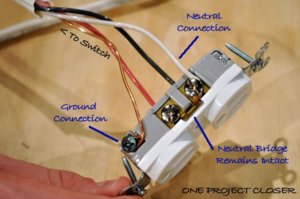
Electricians..... why do they do this?

I understand not wanting to be reliant on the device - but even on a string of outlets around a room where there's only 1 line in and 1 line out, you'd still nut those together and pigtail to the outlet?
On a decent outlet the connecting plate between the screw terminals is pretty substantial and even if the outlet melted would still be connected.
I have and I haven't. Personal preference I'd pigtail to every device because I was taught the most important thing in the trade is reliability, and anything you can do to make each circuit more reliable is worth it. However, when you work for the man you do what the man says, be it backwire, wire through the device, whatever.
 
I understand not wanting to be reliant on the device - but even on a string of outlets around a room where there's only 1 line in and 1 line out, you'd still nut those together and pigtail to the outlet?
On a decent outlet the connecting plate between the screw terminals is pretty substantial and even if the outlet melted would still be connected.

Yep. I pig tail all devices. All the times I've had to repair a device problem it's rarely been on a pigtail device. And i think it's easier to troubleshoot, install and remove the device with only 3 #12 solid cu wires attached to the device.
 
I have and I haven't. Personal preference I'd pigtail to every device because I was taught the most important thing in the trade is reliability, and anything you can do to make each circuit more reliable is worth it. However, when you work for the man you do what the man says, be it backwire, wire through the device, whatever.
If there's only 2 wires, I guess I'm not convinced that the screw terminal plates are any more reliable than a wire nut? But I could certainly be missing something.

On a different but related note - what is the feeling on the new push-in style wire nuts? I've been using them lately but now after thinking about the backstab thing makes me wonder.
 
Yep. I pig tail all devices. All the times I've had to repair a device problem it's rarely been on a pigtail device. And i think it's easier to troubleshoot, install and remove the device with only 3 #12 solid cu wires attached to the device.
That I can definitely see.Although it does add more material to inside the box to have to squeeze in there, but if it's only 1 in/out there's plenty of room anyway.
I guess you go through a lot of wire nuts.
 
That I can definitely see.Although it does add more material to inside the box to have to squeeze in there, but if it's only 1 in/out there's plenty of room anyway.
I guess you go through a lot of wire nuts.
I buy ideal red/yellow wing nuts in the big jugs. I use my klien 7/16 long shaft nut driver to gently push the wires neatly folded in to the back of the box.
 
Having said all this a big part of what I do is Comercial/industrial. Unless I've got unacessable ceilings I put a centralized box above the celing with a raceway to each device. Unless I have no other choice there are only 3 wires going to each rec. This makes troubleshooting and adding the inevitable changes much easier and drastically cuts down on problems.
 
If there's only 2 wires, I guess I'm not convinced that the screw terminal plates are any more reliable than a wire nut? But I could certainly be missing something.

On a different but related note - what is the feeling on the new push-in style wire nuts? I've been using them lately but now after thinking about the backstab thing makes me wonder.
It's like this: With the devices pig-tailed, if you have a failure at a device it affects one device. With the circuit looping through the device you lose the whole circuit beyond said device.

I used the stab-in type wire nuts (we called them Wagos, Way-gos?) at a new construction prison I worked on in eastern NC some 15 years ago. I was working for Berg Electric, a west coast outfit that got really big and last I checked was the 6th largest electrical contractor in the US, but I digress. I hated them then and haven't had to use them anywhere else. To me they're the same as back-wiring, except every damn connection you're making is with some jagged piece of spring metal cutting into your conductor.
 
It's like this: With the devices pig-tailed, if you have a failure at a device it affects one device. With the circuit looping through the device you lose the whole circuit beyond said device.

I understand this logic, but the way the side posts are made, the two screws are literally on the same large piece of metal. Functionally the same as if you double-tapped on the same screw but with better holding. I have a hard time seeing how the device failing could interrupt that. The plates aren't inside or part of the device. Am I wrong? You guys that have done this awhile, do you see issues arising there?
The only thing I could see is if the device shorted internally and connected the hot and neutral bars together. But that would short the whole circuit just like if it was pigtailed...?

I used the stab-in type wire nuts (we called them Wagos, Way-gos?) at a new construction prison I worked on in eastern NC some 15 years ago. I was working for Berg Electric, a west coast outfit that got really big and last I checked was the 6th largest electrical contractor in the US, but I digress. I hated them then and haven't had to use them anywhere else. To me they're the same as back-wiring, except every damn connection you're making is with some jagged piece of spring metal cutting into your conductor.
The thing I hate about them is undoing them is a real pain, especially if it's in a tight or awkward spot.
I only started using them b/c I realized they are what comes in many old-work light fixture housings now.
I'm not a fan of the friction-fit aspect but at least they do have more substantial contact area than the outlet backstabs.
 
Typically the failures I've seen have been backwire related or improper installation. If the electrician makes a good hook that goes all the way around the screw and it's arranged so the hook is closed by tightening the screw there usually aren't any problems. You'd be amazed at what some guys install, wires sticking out the side of a device, no hook on the wire at all, STRANDED wire under a screw with no sta-kon lug, and on, and on. There is the occasional screw that just loosens over time, there's really no avoiding that whether you put one or 5 wires on the device. Sometimes shit just happens.

Now that I've been in a power plant for 10 years, I've seen recepts that the plastics have been completely cooked, become brittle, and broken away, but if you line a plug up just right with the stabs in the receptacle you can plug something in and they still work.
 
I understand this logic, but the way the side posts are made, the two screws are literally on the same large piece of metal. Functionally the same as if you double-tapped on the same screw but with better holding. I have a hard time seeing how the device failing could interrupt that. The plates aren't inside or part of the device. Am I wrong? You guys that have done this awhile, do you see issues arising there?
The only thing I could see is if the device shorted internally and connected the hot and neutral bars together. But that would short the whole circuit just like if it was pigtailed...?


The thing I hate about them is undoing them is a real pain, especially if it's in a tight or awkward spot.
I only started using them b/c I realized they are what comes in many old-work light fixture housings now.
I'm not a fan of the friction-fit aspect but at least they do have more substantial contact area than the outlet backstabs.


Dave,
For me there are 2 things you are missing and why I pigtail harness every recep.
1- Even with the solid plate, there is still the connector tab, which is designed to be broken and spearate the top and bottom as separate circuits. Furthermore if the device itself has a catastrophic internal failure -burouts, short, dterioration (admittedly rare and even rarer to happen and NOT trip a breaker) with a pigtail the balance of the circuits works uninterrupted. This adds convenience for the homeowner and also improves and expedites troubleshooting.
2- This isnt a concern for a Homeowner, but when I am working as a contractor I am thinking about future homeowners. And its much easier and safer for a future unskilled homeowner to swap a device with only 3 wires, and to do it right, than it is for them to swap 6 wires.
 
I understand this logic, but the way the side posts are made, the two screws are literally on the same large piece of metal. Functionally the same as if you double-tapped on the same screw but with better holding. I have a hard time seeing how the device failing could interrupt that.

I've had receptacles come out in three or four pieces before. The plastic gets brittle over time. Matter of fact, I had it happen a couple of weeks ago with a light switch. It was one I pulled from somewhere else and saved. It broke in half when I tightened the screws.

Now I just throw the old stuff away.
 
I've had receptacles come out in three or four pieces before. The plastic gets brittle over time. Matter of fact, I had it happen a couple of weeks ago with a light switch. It was one I pulled from somewhere else and saved. It broke in half when I tightened the screws.

Now I just throw the old stuff away.
But what he's saying, I believe, is no matter the plastics of the device that one plate of metal both screws are on would still be intact, so your circuit would still be complete.
 
But what he's saying, I believe, is no matter the plastics of the device that one plate of metal both screws are on would still be intact, so your circuit would still be complete.

There's nothing there but a little plate that's designed to be broken in two. Once the plastic goes, the screw comes right out.

That said, I'm lazy and only pigtail the ground, or in cases where there are more than two wires in the box.
 
There's nothing there but a little plate that's designed to be broken in two. Once the plastic goes, the screw comes right out.

That said, I'm lazy and only pigtail the ground, or in cases where there are more than two wires in the box.
Ah. So I assumed the screw threaded into the plate. Are you saying it's threaded through the plate and into plastic behind it? I can see that being a problem.
 
No, the screws came out of the box with the little brass plate attached to them. But the two terminals were no longer attached to one another.
 
Here's the best pic I could find of it online. See the little tab between the two screws that they're calling the neutral bridge? That's all that connects the metal the screws are in. But the screws are threaded into the little pieces of metal. Also note the piss poor hook and the white insulation being under the screw...smdh.
 

Attachments

  • outlet-with-markup-one.jpg
    outlet-with-markup-one.jpg
    46.4 KB · Views: 202
Back
Top