Generator, propane plumbing help

Backwoods boy

CORNBREAD KILLER
Joined
Jan 25, 2010
Location
NWNC
I have a propane generator, 3550 watt with 6.75hp briggs and have a question. Im guessing my 100b tank is located around 20-25 feet away from where I'm installing the generator. The tank is used for gas logs in the house also. The piping used was 3/8" OD copper piping. The regulator on the tank is at low pressure 11" Wc (6 ounces) which is what my generator requires as well as the gas logs. My question now is, will the 3/8" OD piping with a run of around 20-25 (T'd off at 20-25 feet to generator) feet be sufficient to carry the amount of propane needed to power the briggs on the generator? Or would i need to move up past 3/8"OD in size? Im thinking it will be sufficient but since i can't really understand the charts, i was gonna see if someone could explain a little better. Thanks.
 
Last edited:
Not sure the I.D but OD is 3/8" and is refrigerant copper pipe. Here is one chart. ( http://www.lp-gasequipment.com/products/pdf/LPGas_Cat2010_p157-175.pdf ) I converted watts to BTU's which 3550 watts would be 12,105 BTU's per hour. (3550x3.41=12,105) 1w=3.41btu's correct? If i understand the chart correctly, the 3/8"OD pipe to 30' would supply up to around 27,000 btu's.... Am i understanding this correctly?
 
Last edited:
the watt to BTU conversion doesnt quite work that way.

The 3,550 watt (3.5kW) rating is an electrical watt rating for the amount electrical energy produced by the machine.

The BTU->watt conversion would be for a measure of the energy of the fuel.

Since no machine is perfectly efficient the engine will need to produce more mechanical wattage (mW) than you will ever extract from the alternator in the form of eW.
IOW a 3500watt generator probably has ~5000watt (6.75hp=5033 watts) engine and that engine will require 7000watts of fuel flow.

This is one reason watts arent used frequently for mechanical power (hp) or fuel flow (btu) to reduce confusion.


I tried to look up specs on the gen to help, but I dont see a 3550 anywhere on Briggs site except for the gasoline portable jobbers. which wont give me required fuel flow info.

In short all generators will require High volume low pressure lp feeds.
If you use a "T" after th regulator it will likel;y suck the pilot out on your gas logs every time the gen starts.


If you can send me a model number or full fuel requirement info I can send you all the info for plumbing it in.
 
Shit or call me 8zero3-6two7-9zero29 and we can figure it out quickly over the phone...
 
Hey Ron, i would call but working right now. The generator is a troy-bilt 1924 model, with 6.75hp briggs motor, 3550w.
 
OK, here is where I'm at... The "t" was already in the line with a cap so i had my buddy run the line to the gen and test everything out while I'm at work. Seems to work awesome. The pilot was on the logs and when he went to crank the gen, we still had the pilot. So he turned the logs on full blast while gen was running (without load) and everything seemed to have enough propane fed to them. I will be running MAYBE 50-60% load if the power goes out during summer without logs or 50-60% load with logs in winter. Things i will be powering during outage would be my security system (dvr w/6 cameras, no monitor needed because i have app on my iPhone, iPad and mac), modem, small freezer for the meat and some small led lights. Will get a load on the gen sometime this week and will update this post.
 
Do regular gensets really vary that much in fuel consumption by load? I thought the rate of LPG suckage in would not change much b/c the unit always runs at the same RPMs.
 
Do regular gensets really vary that much in fuel consumption by load? I thought the rate of LPG suckage in would not change much b/c the unit always runs at the same RPMs.


hard to define what you mean by "regular" but ...the load on the engine is dependent on the electrical load drawn.
When required E increases required power increases and as such required fuel.

Talking specifics, on a 22kW resi unit.
At 25% load it uses 1.1 gallons per hour.
At 100% load it consumes 3.4 gph


The easiest way I can describe it is in 4th gear at 1,800 rpm you are running X mph.
Insert a 10% grade and you will need to provide significant more throttle input to maintain the speed and rpm
 
To assist the OP I cant find any specs on that unit running on LP. So I can't find any required flow rate.

So working backwards.
3/8" (ACR) OD flexible soft copper tubing is good for 25k BTU/hr at 30 foot equivalent.

This wont format for shit but... and keep in mind any bends or 90s in the tubing have to have their equivalent distances calculated. As depending on size a single 90 can be equivalent to 10+' of straight pipe run.

Gas: Undilute Propane
Inlet Pressure: 11.0 in w.c.
Pressure Drop: 0.5 in. w.c.
Specific Gravity: 1.50
Special Use: Sizing between single or second stage (low pressure regulator) and appliance
Tube Size (in.)
K & L 1/4 3/8 1/2 5/8 3/4 1 1 1/4 1 1/2 2 2 1/2
Nominal ACR 3/8 1/2 5/8 3/4 7/8 1 1/8 1 3/8 1 5/8 2 1/8 2 5/8
Outside 0.375 0.500 0.625 0.750 0.875 1.125 1.375 1.625 2.125 2.625
Inside* 0.305 0.402 0.527 0.652 0.745 0.995 1.245 1.481 1.959 2.435
Length (ft) Maximum Capacity in Thousands of Btu per Hour
10 45 93 188 329 467 997 1795 2830 5895 10429
20 31 64 129 226 321 685 1234 1945 4051 7168
30 25 51 104 182 258 550 991 1562 3253 5756
40 21 44 89 155 220 471 848 1337 2784 4926
50 19 39 79 138 195 417 752 1185 2468 4366
60 17 35 71 125 177 378 681 1074 2236 3956
70 16 32 66 115 163 348 626 988 2057 3639
80 15 30 61 107 152 324 583 919 1914 3386
90 14 28 57 100 142 304 547 862 1796 3177
100 13 27 54 95 134 287 517 814 1696 3001
125 11 24 48 84 119 254 458 722 1503 2660
150 10 21 44 76 108 230 415 654 1362 2410
175 10 20 40 70 99 212 382 602 1253 2217
200 8.9 18 37 65 92 197 355 560 1166 2062
225 8.3 17 35 61 87 185 333 525 1094 1935
250 7.9 16 33 58 82 175 315 496 1033 1828
275 7.5 15 31 55 78 166 299 471 981 1736
300 7.1 15 30 52 74 158 285 449 936 1656
* Table capacities are based on Type K copper tubing inside diameter (shown), which has the
smallest inside diameter of the copper tubing products.
Table 6–16. Propane Vapor Semi–Rigid Copper Tubing Sizing26
 
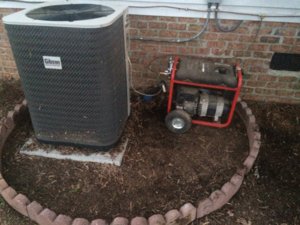
Thanks guys for the replies! I have not yet been able to introduce a load on the unit but plan on it either sometime this week, if not, definitely next weekend. Under no load, everything runs good. So, we will see shortly how everything performs and I will update. It does have a some 90's in the pipe. Pic below.
 

Attachments

  • image.jpg
    image.jpg
    167.1 KB · Views: 260
Last edited:
Sorry, just noticed I never stated the make of gen which is a Troy-bilt model 1924, constant 3600rpm, ohv, 3350 watt 5250 starting. And also, I remember the logs are 30k btu logs and the run from the tank to the logs was 40' with 3 90* bends. Looks more and more like I need to up the size of tubing at least from the tank to the tee which is around 25'.
 
Last edited:
The engine is going to have an efficiency of sub-50%, so that's a good starting point. Take the engine HP in Watts or whatever units you want, double it, and then add a generous factor of safety when sizing to convert to fuel flow.

Also, propane is roughly 75% of the energy of gasoline, so if you have any kind of gasoline consumption numbers for that engine you could approach from that direction...
 
Back
Top