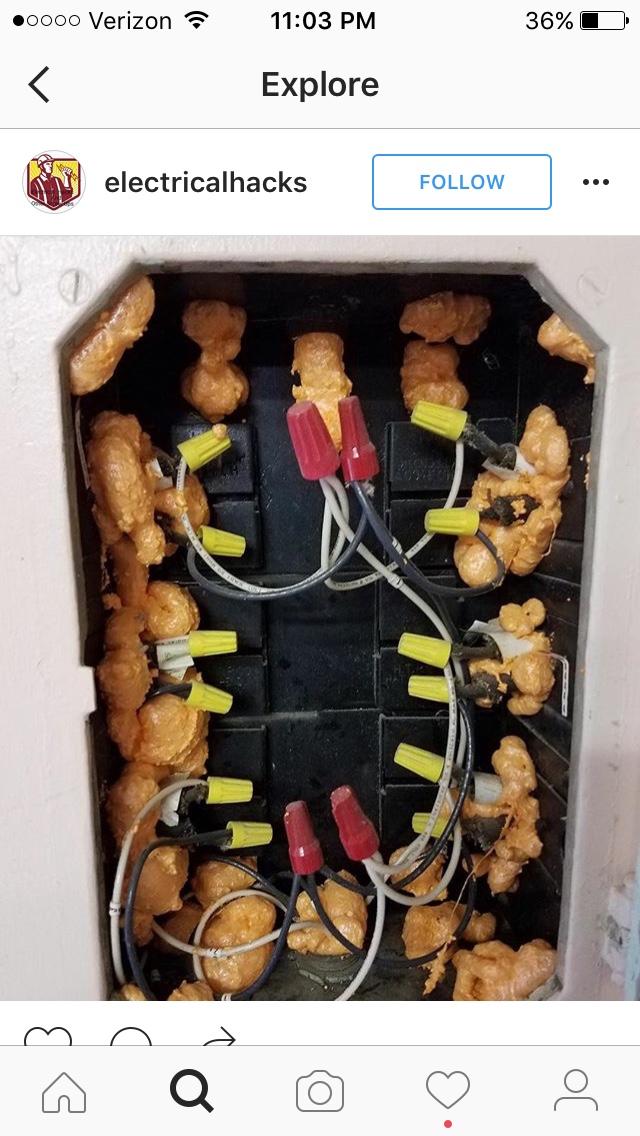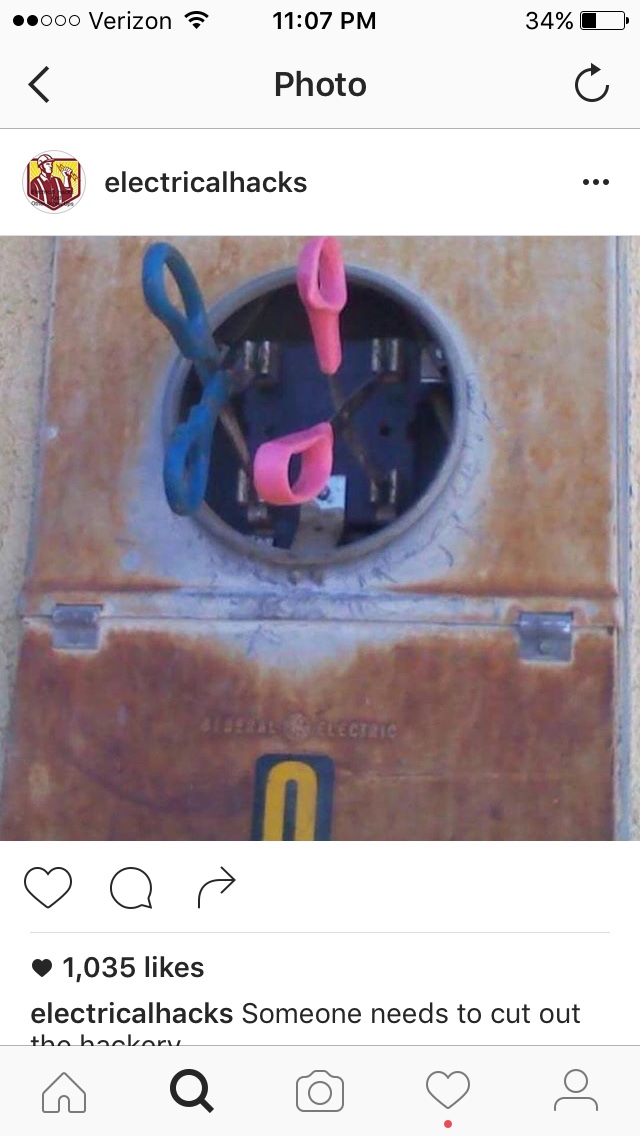
Electricians..... why do they do this?

Wrap electrical tape around the receptical after you make the terminations on the screw down lugs. Early in my career I worked under a licensed electrician that required this on all switches and recepticals on residential and commercial jobs.

Every device gets wrapped in 3M 33+ tape...
 
It basically boils down to the National Electric Code, more specifically the section about Grounding and Bonding. The ground path cannot rely on a device for continuity. All metal parts in a building must be bonded to the ground path, effectively making them the same point electrically. If you use a device such as a receptacle for the ground path because there are two screws on it, and then remove that receptacle, you've broken the path.

I've been an electrician for 18 years. Personally, I despise both back-wiring (using the holes on the back) and wrapping tape on devices or wirenuts, I never have or never will do either. To each his own.
 
Last edited:
70a09db2d5490462f8e1e01bcbd2ac59.jpg


33521a363f2b11d61246a1d747cad3dc.jpg


Funny I stumbled upon this on IG this evening.
 
On a side note ....
Since you are wiring in electronics that operate on RFI you would be better off with the single point ground at every box that a ground loop ( daisy chain ) even if it was ok to do it.
The ground loop would be a possible source of rf hash ( interference ) and could even damage the electronics.
In electric guitars they call it a ground "star" and they like it ..... but I have cured more than one wacked out pick-up by eliminating it.

Matt
 
sure but...with the wire under the screw the screw isnt tightened down as far.
On older receps it isnt an issue.

In the constant drive to cheapen costs, and thereby reduce material utilization, a new GFCI if the wires are under the screws the screw will sit about 1/8" proud of the rest of the body.
The screw is proud of the case of the GFCI body with a wire under it. If you use the terminals on the back, the screw is recessed.

Eh, I still would worry more about the push connection than the screws accidentally hitting the gang box. My grandfather is an electrician and I worked with him for years, I can remember a lot of times we went to a house for a repair and found the wire broken at the push terminal but never once have I seen a wire correctly installed on the screw fail. I have seen some GFCI with electrical tape wrapped around the inside of the outlet covering the screws, I guess for the same fears you have.
 
Eh, I still would worry more about the push connection than the screws accidentally hitting the gang box. My grandfather is an electrician and I worked with him for years, I can remember a lot of times we went to a house for a repair and found the wire broken at the push terminal but never once have I seen a wire correctly installed on the screw fail. I have seen some GFCI with electrical tape wrapped around the inside of the outlet covering the screws, I guess for the same fears you have.
I'm pretty sure he was talking about the push-in-and-screw/clamp type, not a backstab that solely relies on pinched friction.
I can't see any reason the wire on that style would be more susceptible to breaking off than a wrap-around screw. Unless... if the box is a little shallow and the fixture is deep, then if you are careless when pushing the wires sin, they may bend right at the connection (b/c it's at the back) instead of farther up the wire.
 
I'm pretty sure he was talking about the push-in-and-screw/clamp type, not a backstab that solely relies on pinched friction.
I can't see any reason the wire on that style would be more susceptible to breaking off than a wrap-around screw. Unless... if the box is a little shallow and the fixture is deep, then if you are careless when pushing the wires sin, they may bend right at the connection (b/c it's at the back) instead of farther up the wire.

Gotcha, I see what you are saying now. I think most of the problems with the backstab ones is that people shove them in too hard and it stresses it right at the opening. Every one of them that I've seen fail has broken off right there.
 
Gotcha, I see what you are saying now. I think most of the problems with the backstab ones is that people shove them in too hard and it stresses it right at the opening. Every one of them that I've seen fail has broken off right there.
that - I'm sure it creates a little crimp - combined w/ being at the back of the box, so getting more bent to fit in...
but the bigger issue IMO is how poorly it holds, and the minimal mass of the connection. The actual amount of metal connection is tiny, just a tiny point on either side of the wire. So the total contact surface area is only like 2-3 sq mm. In contrast the screw lugs and clamps hold a long section of the wire on both sides, making 10x more surface area both for gripping AND conductance.
 
Thought of this thread. Yesterday I replaced the vent fan switch in our bathroom with a fancy one w/ a hunidistat and automatic on/off built in.
The switch receptacle has a HUGE back on it - see first pic. Note the lugs are inset to the plastic housing - but just barely.
This one had screws but it did have the push-in posts under them to slip in from behind if desired.

When I went to install it - damned if it wasn't a tight fit. Too tight really. It happened to be an old-work box, one of the old metal ones w/ the long metal braces you clip in from the sides. Of course the PO had done the right thing and grounded the box, which I tied the fixture into also - and when I went to slide it in, the fixture literally filled the whole space (see 2nd pic). seeing how tight it'd be I wrapped the fixture w/ electrical tape but it was so tight the tape even rubbed off as I pushed it in... leaving the hot terminal < 2mm from the grounded box.

I just didn't feel comfy with this, so today I pulled the whole box out, widened the hole and put in a modern plastic old-work box, just so there'd be more room.
Oh and lol in the process of doing that I found there's some random old low-voltage wire ended just a-hangin' inside the wall there... who knows wtf that went to. 20170114_213411[1].jpg 20170114_221616[1].jpg
 
Oh, something else that was odd about that fixture - instead of having the 2 hot wires on the same side, it was set w/ one side as hot in (on top) and ground in the middle (can see in the pic), other side was neutral on top, hot out on bottom.
 
Plate screws all facing vertical are a must. Fixed every screw in the new house the second day we lived here.

So, anytime one of y'all happen to visit GotWood's house, take your screwdriver. As you leave...show him the screwdriver. Tell him ONE screw is now horizontal.
 
So, anytime one of y'all happen to visit GotWood's house, take your screwdriver. As you leave...show him the screwdriver. Tell him ONE screw is now horizontal.
I'd rather change 2 but tell him I did 1. That way he'll fins one and quit, then the other sometime later and freak out.
 
I've got a stack of plates in the shop without screws. I always lose those things. No worries just grab another cover and throw it in me electrical bucket.


Sent from my iPhone using Tapatalk
 
Fuck that noise, I only use cover plates with hidden screws. Looks much cleaner and modern.

But seriously, I would start to legitimately worry about you if you're actually concerned about the direction of the slots in a flatheat screw.

I've put helpers sweeping for a day that wouldn't make the cover screws all vertical and neat. The rec or switch is one of the few visible aspects of the trade. It has to be right!
 
Never ever ever use the stabs! Don't feed through unless you want it to fail. 1 hot 1 neutral 1 gnd to each rec with the wire looped around the screw as to tighten with the screw. And use 20 amp devices even on 15 amp circuits, just better quality and connection. If done properly the device and associated wire will last forever. Using stabs, feed throughs and cheap devices will make you do the work twice and might burn down the house.
 
Don't feed through unless you want it to fail. 1 hot 1 neutral 1 gnd to each rec with the wire looped around the screw as to tighten with the screw.
I understand not wanting to be reliant on the device - but even on a string of outlets around a room where there's only 1 line in and 1 line out, you'd still nut those together and pigtail to the outlet?
On a decent outlet the connecting plate between the screw terminals is pretty substantial and even if the outlet melted would still be connected.
 
Back
Top